 Fireblaze
 Learning Guides
Python 3.9: Features, Improvements, and Complete Beginner's Guide
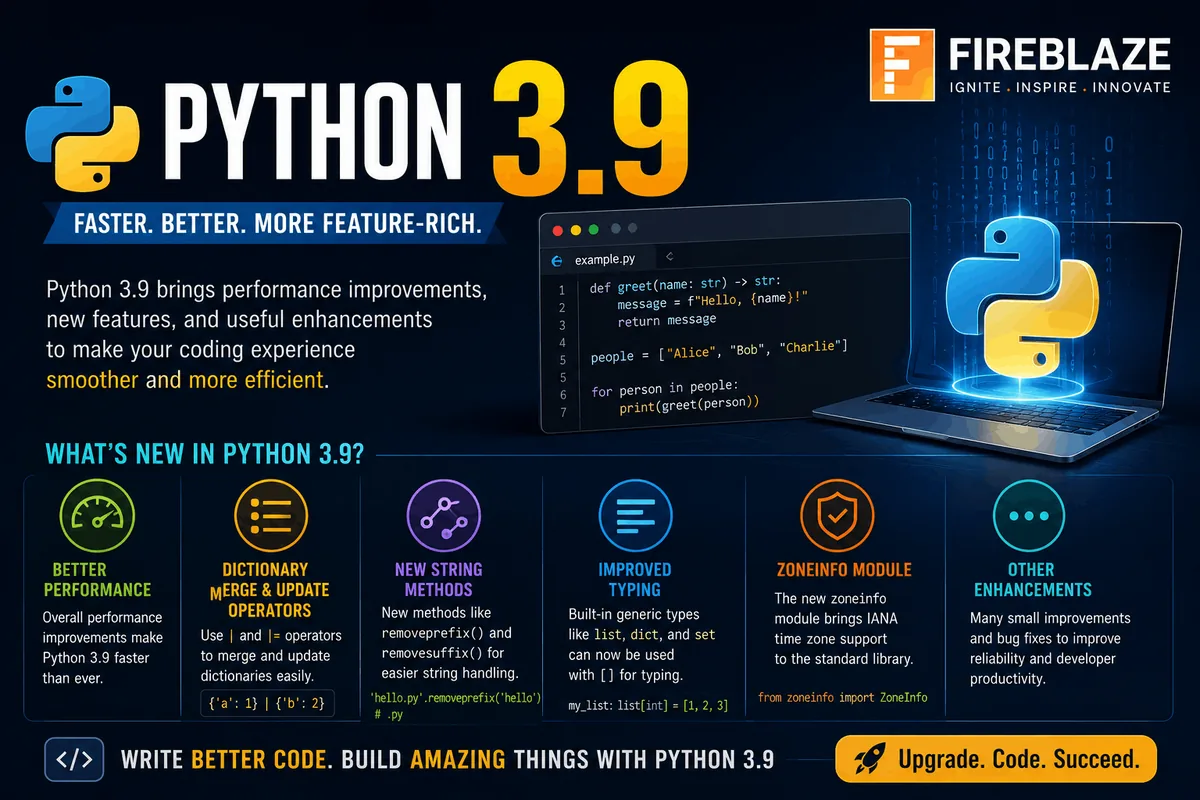
Python is one of the most popular programming languages in the world, known for its simplicity, readability, and versatility. It is widely used in:
Web Development
Data Science
Machine Learning
Artificial Intelligence
Automation
Cybersecurity
Cloud Computing
With every release, Python introduces improvements that make development faster and more efficient.
One such important release was:
Python 3.9
Python 3.9 introduced several enhancements that improved syntax, performance, developer experience, and code readability.
In this guide, you'll learn:
What Python 3.9 is
New features introduced
Syntax improvements
Type hinting updates
Dictionary enhancements
String method additions
Real-world applications
What is Python 3.9?
Python 3.9 is a major version update of the Python programming language that introduced several new features while improving existing functionality.
The primary goals of Python 3.9 were:
Cleaner syntax
Better readability
Improved developer productivity
Enhanced type checking
Performance optimization
Why Python 3.9 Matters
Python continues to evolve to make coding simpler and more expressive.
Benefits of Python 3.9 include:
Less code
Better readability
Faster development
Improved maintainability
Enhanced type annotations
These improvements help both beginners and professional developers.
Dictionary Merge Operators
One of the most popular additions in Python 3.9 is:
Dictionary Merge Operator
Using:
|
developers can merge dictionaries easily.
Example:
dict1 = {"name": "John"}
dict2 = {"age": 25}

result = dict1 | dict2

print(result)
Output:
{
    "name": "John",
    "age": 25
}
Dictionary Update Operator
Python 3.9 also introduced:
|=
Example:
data = {"name": "John"}

data |= {"city": "London"}

print(data)
Output:
{
    "name": "John",
    "city": "London"
}
This provides a cleaner alternative to traditional update methods.
New String Methods
Python 3.9 introduced:
removeprefix()
and
removesuffix()
removeprefix()
Example:
text = "PythonProgramming"

print(
text.removeprefix("Python")
)
Output:
Programming
removesuffix()
Example:
text = "report.pdf"

print(
text.removesuffix(".pdf")
)
Output:
report
These methods simplify string manipulation tasks.
Improved Type Hinting
Python has increasingly focused on static type checking.
Python 3.9 introduced simpler type annotations.
Old syntax:
from typing import List

names: List[str]
New syntax:
names: list[str]
This is shorter and easier to read.
Built-in Collection Type Hints
Python 3.9 allows type hints directly on built-in collections.
Example:
ages: dict[str, int]
Instead of:
from typing import Dict

ages: Dict[str, int]
Benefits include:
Cleaner code
Better readability
Reduced imports
ZoneInfo Module
Python 3.9 introduced:
zoneinfo
This module provides support for time zones.
Example:
from zoneinfo import ZoneInfo
Applications:
Scheduling systems
Global applications
Time-based analytics
Improved Standard Library
Python 3.9 improved several standard library modules.
Examples include:
datetime
typing
collections
pathlib
These enhancements improve reliability and usability.
Parser Improvements
Python 3.9 introduced a new parser known as:
PEG Parser
PEG stands for:
Parsing Expression Grammar
Benefits include:
Better syntax handling
Future language improvements
Improved maintainability
Better Error Messages
Python 3.9 improved debugging by providing clearer error messages.
Example:
Instead of vague syntax errors, developers receive more descriptive messages.
Benefits:
Faster debugging
Better learning experience
Easier troubleshooting
Working with Pathlib
Python 3.9 expanded functionality within:
pathlib
Pathlib simplifies file and directory management.
Example:
from pathlib import Path

file = Path("data.txt")

print(file.exists())
Applications:
File management
Data pipelines
Automation scripts
Performance Improvements
Python 3.9 includes several internal optimizations.
Benefits:
Faster execution
Better memory management
Improved runtime efficiency
While individual gains may be small, large applications benefit significantly.
Example Program Using Python 3.9 Features
user = {
    "name": "John"
}

details = {
    "age": 25
}

profile = user | details

print(profile)

filename = "report.pdf"

print(
filename.removesuffix(".pdf")
)
Output:
{
    "name": "John",
    "age": 25
}

report
Advantages of Python 3.9
Cleaner Syntax
Code becomes easier to read and maintain.
Improved Developer Productivity
Less code is required for common tasks.
Better Type Checking
Supports modern development practices.
Enhanced Standard Library
Provides more built-in functionality.
Easier String Processing
New methods simplify text handling.
Real-World Applications of Python 3.9
Web Development
Frameworks:
Django
Flask
FastAPI
Data Science
Libraries:
Pandas
NumPy
Scikit-Learn
Machine Learning
Applications:
Predictive Analytics
Recommendation Systems
Deep Learning
Automation
Examples:
Web Scraping
File Processing
Reporting Systems
Cloud Applications
Used for:
APIs
Microservices
Cloud Automation
Python 3.9 vs Older Versions
| Feature | Python 3.8 | Python 3.9 |
|---|---|---|
| Dictionary Merge Operator | ❌ | ✅ |
| removeprefix() | ❌ | ✅ |
| removesuffix() | ❌ | ✅ |
| Built-in Generic Types | ❌ | ✅ |
| ZoneInfo Module | ❌ | ✅ |
| PEG Parser | ❌ | ✅ |
Common Interview Questions
What is Python 3.9?
Python 3.9 is a major release that introduced syntax improvements, new string methods, type hint enhancements, and performance optimizations.
What is the Dictionary Merge Operator?
|
Used to combine dictionaries.
What are removeprefix() and removesuffix()?
String methods used to remove specified prefixes and suffixes.
What is ZoneInfo?
A standard library module for handling time zones.
What is the PEG Parser?
A new parser architecture that improves Python's syntax processing capabilities.
Best Practices While Using Python 3.9
Use built-in generic types.
Adopt modern type hints.
Use dictionary merge operators where appropriate.
Leverage pathlib for file handling.
Write clean and readable code.
Future of Python Development
Python 3.9 laid the foundation for many improvements introduced in later versions.
Developers who understand Python 3.9 concepts can easily transition to:
Python 3.10
Python 3.11
Python 3.12
Future Python releases
The language continues to evolve while maintaining its simplicity and readability.
Final Thoughts
Python 3.9 introduced several valuable enhancements that make coding cleaner, simpler, and more productive. Features such as dictionary merge operators, new string methods, built-in generic type hints, and the ZoneInfo module significantly improve the developer experience.
Whether you're a beginner learning Python or an experienced developer building production applications, understanding Python 3.9 features can help you write more efficient, maintainable, and modern Python code.
Keep Reading
Related Articles
Learning Guides
Language Translation Using Deep Learning: A Complete Guide
Discover how Deep Learning powers modern language translation systems. Learn Neural Machine Translation, Transformer models, Seq2Seq architecture, applications,
Data Science Learning Hub: Tutorials, Interview Questions, Projects & Career Resources
Explore Data Science tutorials, Machine Learning guides, Python and SQL resources, interview questions, projects, career roadmaps, analytics concepts, and AI le
Core Operations in Image Processing: A Complete Guide
Explore the fundamental operations in image processing used in Computer Vision and Artificial Intelligence. Learn image enhancement, filtering, segmentation, ed