Infogain Data Science Interview Questions and Answers (2026 Guide)
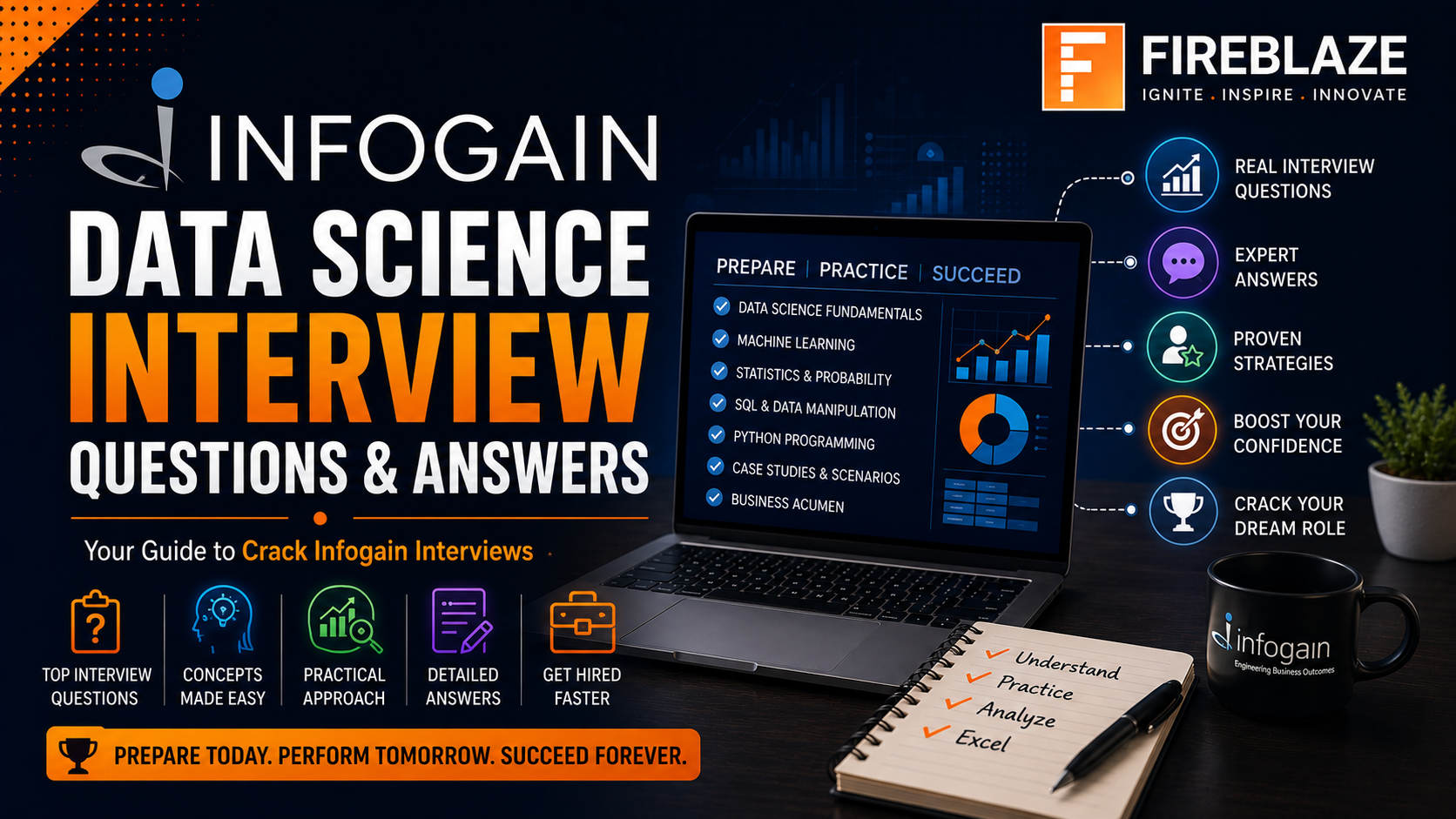
Infogain Data Science Interview Questions and Answers (2026 Guide)
Data Science and Artificial Intelligence have become critical components of digital transformation initiatives across industries. Organizations increasingly rely on data-driven insights, predictive analytics, and machine learning solutions to improve decision-making, optimize operations, and create better customer experiences.
Infogain is a leading digital engineering and software solutions company that helps organizations accelerate innovation through Data Science, Artificial Intelligence, Cloud Technologies, Automation, and Advanced Analytics.
If you're preparing for an Infogain Data Science interview, understanding the interview process and commonly asked questions can significantly improve your chances of success.
About Infogain
Infogain provides services across:
Digital Engineering
Artificial Intelligence
Data Analytics
Cloud Solutions
Software Development
Business Intelligence
Automation
The company uses Data Science for:
Customer Analytics
Predictive Modeling
Business Intelligence
Process Optimization
Recommendation Systems
Forecasting
AI Solutions Development
Infogain actively hires:
Data Scientists
Data Analysts
Machine Learning Engineers
Analytics Consultants
Business Intelligence Analysts
Infogain Interview Process
The hiring process generally includes multiple rounds.
1. Online Assessment
Topics may include:
Aptitude Questions
SQL Queries
Python Programming
Statistics Questions
Logical Reasoning
2. Technical Interview
Topics commonly covered include:
SQL
Python
Statistics
Machine Learning
Data Analytics
3. Analytics Round
Candidates may receive:
Business Analytics Cases
Data Interpretation Problems
Predictive Modeling Scenarios
Customer Analytics Questions
4. Managerial Round
Focus areas include:
Project Experience
Problem Solving
Communication Skills
Stakeholder Management
5. HR Interview
Topics include:
Career Goals
Team Collaboration
Leadership Skills
Organizational Fit
SQL Interview Questions Asked in Infogain
What is SQL?
SQL (Structured Query Language) is used to retrieve, manage, and analyze data stored in relational databases.
What is an INNER JOIN?
INNER JOIN returns matching records from multiple tables.
SELECT *
FROM Customers
INNER JOIN Orders
ON Customers.Customer_ID =
Orders.Customer_ID;
Difference Between WHERE and HAVING
| WHERE | HAVING |
|---|---|
| Filters rows | Filters grouped results |
| Applied before GROUP BY | Applied after GROUP BY |
What are Window Functions?
SELECT
Customer_ID,
Revenue,
RANK() OVER(
ORDER BY Revenue DESC
) AS Revenue_Rank
FROM Customer_Data;
Window functions perform calculations across rows while retaining individual records.
What is a Common Table Expression (CTE)?
CTE stands for:
Common Table Expression
Used to simplify complex SQL queries.
Python Interview Questions
Why is Python Used in Data Science?
Python provides powerful libraries for:
Data Analysis
Automation
Machine Learning
Data Visualization
Popular libraries include:
Pandas
NumPy
Scikit-Learn
Matplotlib
Seaborn
Difference Between List and Tuple
| List | Tuple |
|---|---|
| Mutable | Immutable |
| Uses [] | Uses () |
What is Pandas?
Pandas is used for:
Data Cleaning
Data Manipulation
Data Analysis
Reporting
Statistics Interview Questions
What is Mean, Median, and Mode?
Mean
Average value.
Median
Middle value in sorted data.
Mode
Most frequently occurring value.
What is Standard Deviation?
Standard deviation measures variability around the mean.
What is Correlation?
Correlation measures relationships between variables.
Range:
-1 to +1
What is Hypothesis Testing?
Hypothesis Testing determines whether observed results are statistically significant.
Important concepts:
Null Hypothesis
Alternative Hypothesis
P-Value
Confidence Interval
Machine Learning Interview Questions
Difference Between Supervised and Unsupervised Learning
| Supervised Learning | Unsupervised Learning |
|---|---|
| Uses labeled data | Uses unlabeled data |
| Predicts outcomes | Discovers patterns |
What is Overfitting?
Overfitting occurs when a model performs well on training data but poorly on unseen data.
Solutions:
Cross Validation
Regularization
More Data
What is Cross Validation?
Cross Validation evaluates model performance using multiple subsets of data.
Popular method:
K-Fold Cross Validation
What is Feature Engineering?
Feature Engineering involves creating meaningful variables that improve model performance.
Examples:
Customer Lifetime Value
Purchase Frequency
Engagement Score
Revenue Index
Data Analytics Questions
What is Data Analytics?
Data Analytics is the process of examining data to uncover patterns, trends, and actionable insights.
Types of Data Analytics
Descriptive Analytics
What happened?
Diagnostic Analytics
Why did it happen?
Predictive Analytics
What will happen?
Prescriptive Analytics
What should be done?
What is Exploratory Data Analysis (EDA)?
EDA helps identify:
Trends
Patterns
Relationships
Outliers
before model development.
Artificial Intelligence Questions
What is Artificial Intelligence?
Artificial Intelligence refers to systems that simulate human intelligence and decision-making.
Applications include:
Chatbots
Recommendation Systems
Computer Vision
NLP Solutions
What is Machine Learning?
Machine Learning is a subset of AI that enables systems to learn from data without explicit programming.
What is Deep Learning?
Deep Learning uses neural networks with multiple layers to solve complex tasks.
Applications include:
Image Recognition
Speech Processing
Language Translation
Infogain Case Study Questions
Customer Churn Prediction
How would you identify customers likely to leave?
Approach
Analyze customer behavior
Identify churn indicators
Build predictive models
Recommend retention strategies
Sales Forecasting
How would you predict future sales?
Approach
Historical trend analysis
Seasonality analysis
Predictive modeling
Forecast validation
Customer Segmentation
How would you group customers?
Approach
Analyze demographics
Study behavioral patterns
Apply clustering algorithms
Create customer profiles
Business Process Optimization
How would you improve operational efficiency?
Approach
Analyze process data
Identify bottlenecks
Recommend automation
Measure performance improvements
Data Visualization Questions
Why is Data Visualization Important?
Visualization helps communicate insights effectively.
Benefits include:
Better understanding
Faster decision-making
Improved stakeholder communication
Popular Visualization Tools
Power BI
Tableau
Excel
Looker Studio
Dashboard vs Report
| Dashboard | Report |
|---|---|
| Interactive | Detailed |
| Real-Time Metrics | Historical Analysis |
Business Intelligence Questions
What is KPI?
KPI stands for:
Key Performance Indicator
Examples:
Revenue Growth
Customer Retention
Conversion Rate
Customer Satisfaction
What is Business Intelligence?
Business Intelligence transforms raw data into actionable business insights.
Project-Based Questions
Explain a Data Science Project
Recommended structure:
Business Problem
Dataset
Data Cleaning
Feature Engineering
Model Development
Evaluation Metrics
Business Impact
How Did You Handle Missing Values?
Common methods include:
Mean Imputation
Median Imputation
Mode Imputation
Interpolation
Row Removal
Which Tools Have You Used?
Examples:
SQL
Python
Tableau
Power BI
Excel
HR Interview Questions
Tell Me About Yourself
Structure:
Education
Technical Skills
Projects
Experience
Career Goals
Why Infogain?
Sample Answer:
"I am interested in Infogain because of its strong focus on digital transformation, data-driven innovation, and emerging technologies. The opportunity to apply Data Science, Analytics, and Artificial Intelligence to solve real-world business challenges aligns perfectly with my career goals."
What Are Your Strengths?
Examples:
Analytical Thinking
Problem Solving
Communication Skills
Adaptability
Team Collaboration
Preparation Tips for Infogain Data Science Interviews
Strengthen SQL Skills
Practice:
Joins
Aggregations
Window Functions
Subqueries
CTEs
Improve Python Skills
Focus on:
Pandas
NumPy
Data Cleaning
Data Manipulation
Revise Statistics
Important topics:
Probability
Correlation
Hypothesis Testing
Statistical Distributions
Learn Machine Learning Concepts
Focus on:
Regression
Classification
Clustering
Model Evaluation
Practice Business Case Studies
Focus on:
Customer Analytics
Forecasting
Segmentation
Business Optimization
Final Thoughts
Infogain looks for candidates who can combine technical expertise, analytical thinking, and business problem-solving abilities. Strong SQL skills, Python programming, Statistics knowledge, Machine Learning fundamentals, and Data Analytics experience can significantly improve your chances of success.
Whether you're preparing for a Data Scientist, Data Analyst, Machine Learning Engineer, Analytics Consultant, or Business Intelligence Analyst role, consistent practice, hands-on projects, and strong communication skills will help you perform confidently during the Infogain Data Science interview process.