How to Make a Successful Career Transition into Data Science
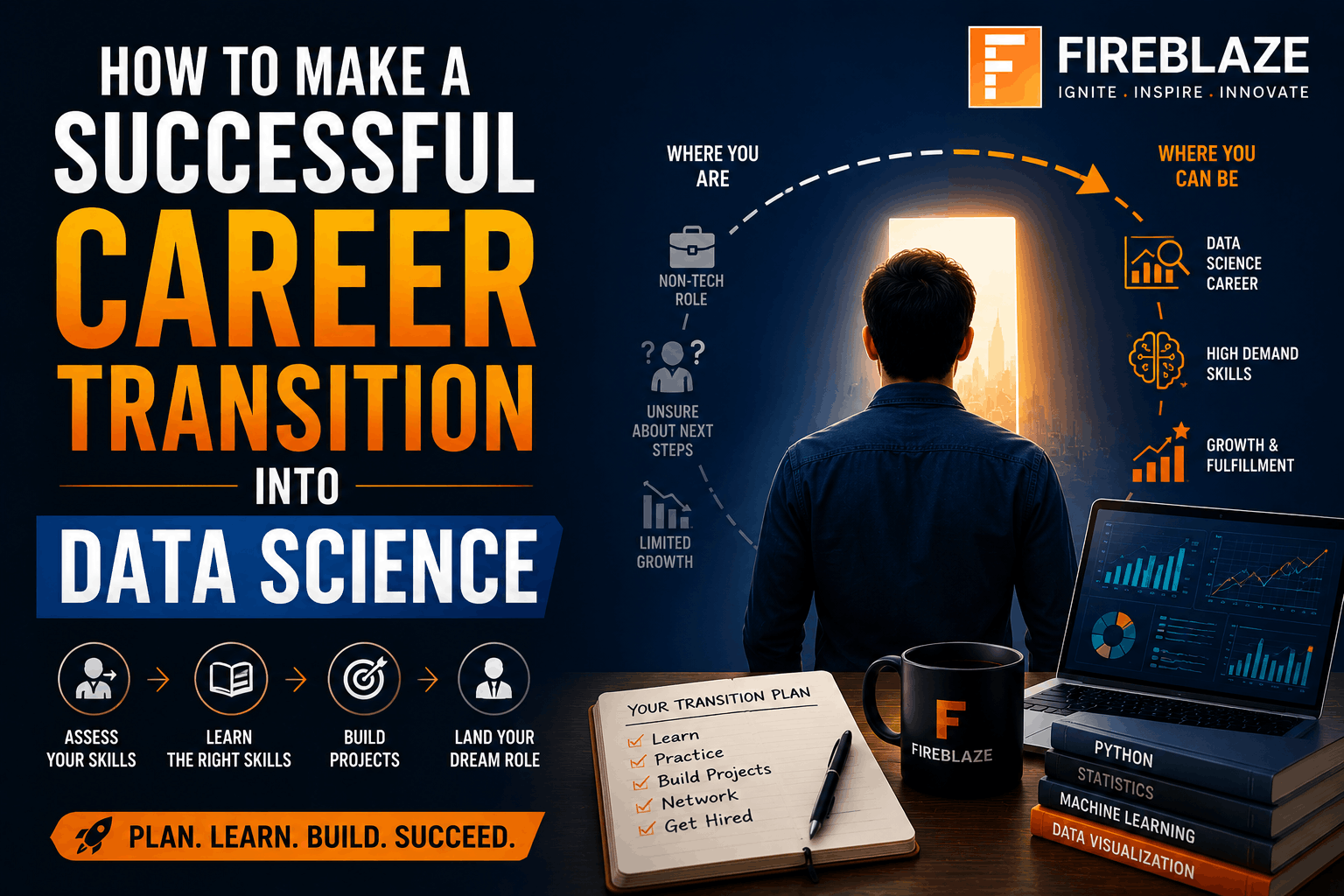
How to Make a Successful Career Transition into Data Science
Data Science has emerged as one of the fastest-growing and most rewarding career fields in the modern digital economy. Organizations across industries are investing heavily in data-driven decision-making, Artificial Intelligence, Machine Learning, and Business Analytics.
As a result, professionals from various backgrounds are exploring opportunities to transition into Data Science.
The good news is:
You do not need a Computer Science degree to become a Data Scientist.
Many successful Data Scientists started their careers in:
Software Development
Mechanical Engineering
Civil Engineering
Finance
Marketing
Healthcare
Education
Operations
Business Management
In this guide, you'll learn exactly how to make a successful transition into Data Science.
Why So Many Professionals Are Switching to Data Science
Data Science offers several advantages:
High demand
Competitive salaries
Diverse career opportunities
Continuous learning
Global job market
Opportunities in AI and Machine Learning
Organizations need professionals who can transform data into actionable business insights.
This demand continues to grow across industries.
Is Data Science Right for You?
Before transitioning, ask yourself:
Do you enjoy solving problems?
Do you like working with data?
Are you curious about patterns and trends?
Are you willing to learn continuously?
If your answer is yes, Data Science can be an excellent career choice.
Common Myths About Data Science
Many people hesitate because of misconceptions.
Myth 1: You Need a Computer Science Degree
False.
Many Data Scientists come from non-technical backgrounds.
What matters most is:
Skills
Projects
Problem-solving ability
Myth 2: You Must Be an Expert in Mathematics
False.
You need a practical understanding of:
Statistics
Probability
Linear Algebra fundamentals
You do not need advanced academic mathematics to begin.
Myth 3: Data Science Is Only About Coding
False.
Data Science combines:
Business understanding
Statistics
Communication
Data Analysis
Machine Learning
Coding is only one part of the process.
Understanding the Data Science Career Path
A typical Data Science journey often includes roles such as:
Data Analyst
→ Business Analyst
→ Data Scientist
→ Senior Data Scientist
→ AI/ML Specialist
Many professionals begin with Data Analysis and gradually move toward Machine Learning and Artificial Intelligence.
Step 1: Learn Python Programming
Python is the most widely used language in Data Science.
Key topics include:
Variables
Data Types
Functions
Loops
Lists
Dictionaries
Object-Oriented Programming
Why Python?
Easy to learn
Huge community support
Industry standard
Step 2: Learn Statistics
Statistics forms the foundation of Data Science.
Important concepts:
Descriptive Statistics
Mean
Median
Mode
Standard Deviation
Inferential Statistics
Hypothesis Testing
Confidence Intervals
Sampling Techniques
Probability
Conditional Probability
Probability Distributions
Bayes Theorem
Step 3: Learn SQL
SQL is one of the most important skills in Data Science interviews.
Important topics:
SELECT Statements
Filtering
Joins
GROUP BY
Window Functions
Subqueries
CTEs
Most organizations expect Data Scientists to work with databases.
Step 4: Master Data Analysis
Data Analysis helps uncover patterns and insights.
Skills include:
Data Cleaning
Data Transformation
Exploratory Data Analysis (EDA)
Data Visualization
Popular libraries:
Pandas
NumPy
Step 5: Learn Data Visualization
Insights are only valuable if they can be communicated effectively.
Popular tools:
Power BI
Tableau
Excel
Popular Python libraries:
Matplotlib
Seaborn
Plotly
Step 6: Understand Machine Learning
After mastering fundamentals, move to Machine Learning.
Supervised Learning
Examples:
Linear Regression
Logistic Regression
Random Forest
Decision Trees
Unsupervised Learning
Examples:
K-Means Clustering
Hierarchical Clustering
PCA
Model Evaluation
Important metrics:
Accuracy
Precision
Recall
F1 Score
ROC-AUC
Step 7: Build Real Projects
Projects are often more valuable than certifications.
Examples:
Customer Churn Prediction
House Price Prediction
Sales Forecasting
Fraud Detection
Recommendation Systems
Projects demonstrate:
Practical skills
Business understanding
Problem-solving ability
Step 8: Create a Strong Portfolio
Your portfolio should include:
GitHub Projects
Dashboards
Case Studies
Machine Learning Models
A strong portfolio can significantly increase interview opportunities.
Step 9: Gain Real-World Experience
Ways to gain experience:
Internships
Freelance Projects
Open Source Contributions
Kaggle Competitions
Experience helps bridge the gap between learning and employment.
Step 10: Prepare for Interviews
Most Data Science interviews focus on:
SQL
Python
Statistics
Machine Learning
Projects
Business Case Studies
Practice regularly through mock interviews.
How Different Professionals Can Transition into Data Science
Software Developers
Strengths:
Programming knowledge
Problem-solving skills
Focus on:
Statistics
Machine Learning
Data Analysis
Engineers
Strengths:
Mathematics
Analytical thinking
Focus on:
Python
SQL
Data Visualization
Finance Professionals
Strengths:
Data interpretation
Business understanding
Focus on:
Programming
Machine Learning
Marketing Professionals
Strengths:
Customer Analytics
Business Strategy
Focus on:
SQL
Statistics
Predictive Analytics
Healthcare Professionals
Strengths:
Domain expertise
Analytical thinking
Focus on:
Python
Data Analysis
Machine Learning
Skills Recruiters Look For
Technical Skills:
Python
SQL
Statistics
Machine Learning
Data Visualization
Business Skills:
Problem Solving
Critical Thinking
Business Understanding
Soft Skills:
Communication
Presentation Skills
Team Collaboration
Adaptability
Common Mistakes During Career Transition
Trying to Learn Everything at Once
Focus on one topic at a time.
Ignoring Fundamentals
Strong foundations lead to long-term success.
Watching Tutorials Without Building Projects
Practical implementation is critical.
Collecting Certifications Only
Projects and skills matter more than certificates.
Applying Too Late
Start applying once you have:
Core skills
Projects
Portfolio
Suggested Learning Timeline
| Stage | Duration |
|---|---|
| Python | 1–2 Months |
| Statistics | 1–2 Months |
| SQL | 1 Month |
| Data Analysis | 1–2 Months |
| Machine Learning | 2–3 Months |
| Projects | Ongoing |
Many professionals become job-ready within 6–12 months of consistent learning.
Career Opportunities After Transitioning
Popular roles include:
Data Analyst
Business Analyst
Data Scientist
Machine Learning Engineer
AI Engineer
Analytics Consultant
Industries hiring Data Science professionals:
Banking
Healthcare
Retail
E-Commerce
Technology
Manufacturing
How to Stay Motivated During the Transition
The transition journey can sometimes feel overwhelming.
Remember:
Focus on progress, not perfection.
Build projects consistently.
Learn from failures.
Network with professionals.
Celebrate small achievements.
Consistency is more important than speed.
Final Thoughts
Transitioning into Data Science is one of the most achievable and rewarding career moves in today's job market. With a structured roadmap, practical learning approach, strong portfolio, and consistent effort, professionals from almost any background can successfully enter the field.
The key is to focus on fundamentals, build real-world projects, develop problem-solving skills, and continuously improve your technical and communication abilities. Data Science is not just about algorithms and code—it's about using data to solve meaningful problems and create value.
If you stay disciplined, curious, and committed to learning, a successful Data Science career is absolutely within your reach.