Hierarchical Clustering in Machine Learning: A Complete Beginner's Guide
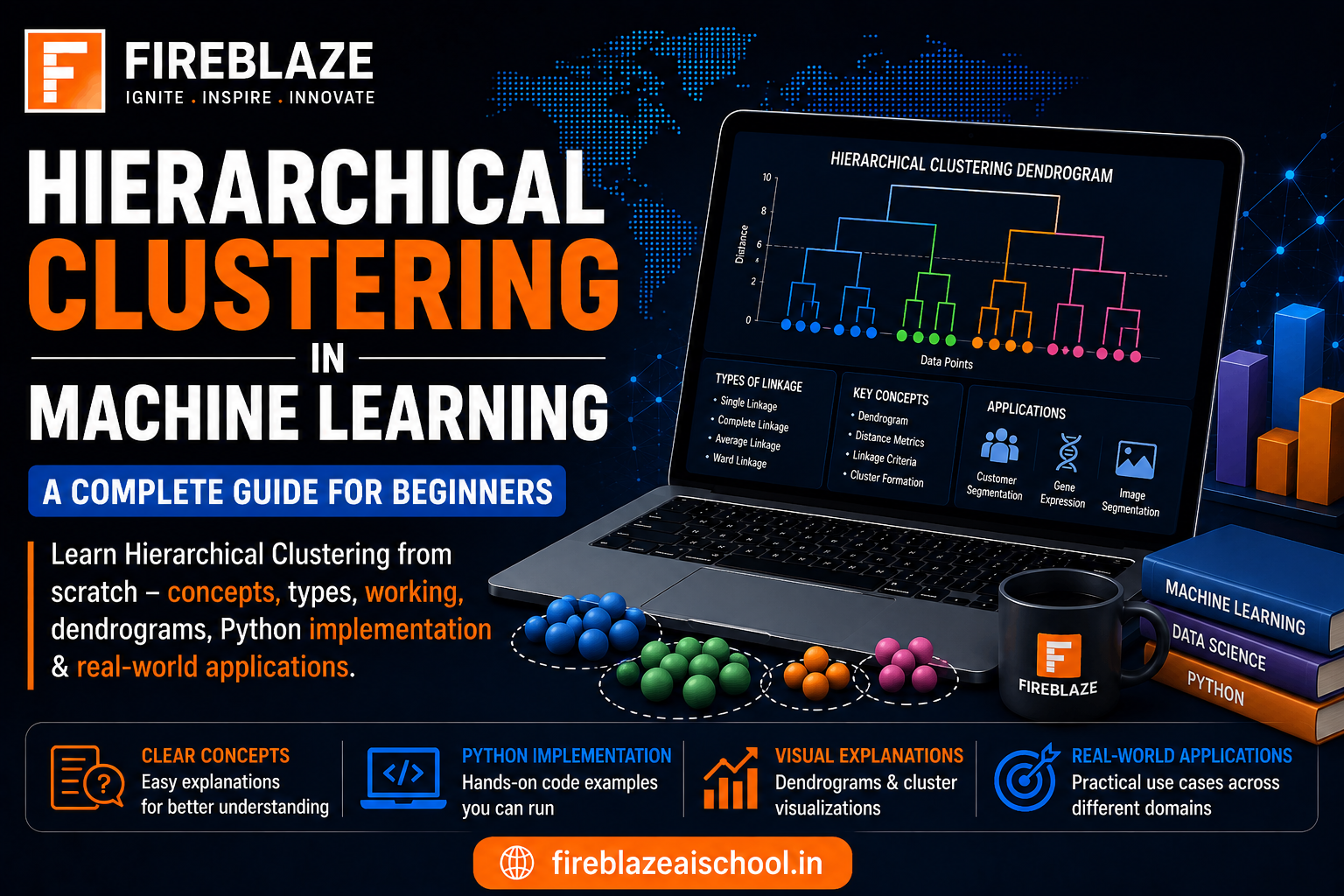
Hierarchical Clustering in Machine Learning: A Complete Beginner's Guide
Machine Learning helps organizations uncover hidden patterns in data. While many machine learning techniques require labeled datasets, some algorithms can discover patterns without predefined labels.
One such powerful unsupervised learning technique is Hierarchical Clustering.
Hierarchical Clustering is widely used in customer segmentation, recommendation systems, biological research, market analysis, and pattern recognition.
In this guide, you'll learn:
What Hierarchical Clustering is
How it works
Types of Hierarchical Clustering
Dendrograms
Advantages and Limitations
Real-world Applications
Career Relevance in Data Science and Machine Learning
What is Hierarchical Clustering?
Hierarchical Clustering is an unsupervised machine learning algorithm used to group similar data points into clusters.
Unlike K-Means Clustering, Hierarchical Clustering does not require specifying the number of clusters beforehand.
Instead, it builds a hierarchy of clusters and represents them using a tree-like structure called a Dendrogram.
The goal is to identify natural groupings within the dataset.
Why Use Hierarchical Clustering?
Hierarchical Clustering is useful when:
The number of clusters is unknown.
Relationships between clusters need visualization.
Exploratory Data Analysis (EDA) is being performed.
Data contains natural hierarchical relationships.
It helps analysts understand how data points are related at different levels.
Types of Hierarchical Clustering
There are two primary approaches.
1. Agglomerative Clustering (Bottom-Up)
This is the most commonly used approach.
Process:
Each data point starts as its own cluster.
The two closest clusters are merged.
The process repeats until all points belong to one cluster.
Example:
A  B  C  D

Step 1:
(A) (B) (C) (D)

Step 2:
(A,B) (C) (D)

Step 3:
(A,B) (C,D)

Step 4:
(A,B,C,D)
2. Divisive Clustering (Top-Down)
Process:
All data points start in a single cluster.
The cluster is repeatedly split into smaller clusters.
Splitting continues until each point becomes its own cluster.
This method is less commonly used due to higher computational cost.
What is a Dendrogram?
A Dendrogram is a tree-like diagram used to visualize hierarchical relationships between clusters.
It shows:
Which clusters merge
At what distance clusters merge
Natural grouping patterns
Example:
        --------
       |        |
     ----     ----
    |    |   |    |
    A    B   C    D
The height of the branches represents the distance between clusters.
Analysts use dendrograms to determine the optimal number of clusters.
How Hierarchical Clustering Works
The process generally follows these steps:
Step 1: Calculate Distance Matrix
Distances between all data points are calculated.
Common distance metrics:
Euclidean Distance
Manhattan Distance
Cosine Similarity
Step 2: Find Closest Clusters
The nearest clusters are identified.
Step 3: Merge Clusters
Closest clusters are combined.
Step 4: Update Distance Matrix
Distances are recalculated based on the newly formed cluster.
Step 5: Repeat
Continue until all points belong to one cluster.
Linkage Methods in Hierarchical Clustering
Linkage determines how cluster distances are calculated.
Single Linkage
Uses the shortest distance between points in two clusters.
Complete Linkage
Uses the maximum distance between points.
Average Linkage
Uses the average distance between all points.
Ward's Linkage
Minimizes variance within clusters.
Ward's method is often preferred for producing balanced clusters.
Hierarchical Clustering Using Python
Import Libraries
import matplotlib.pyplot as plt
from scipy.cluster.hierarchy import dendrogram, linkage
Sample Dataset
data = [[1,2],
        [2,3],
        [3,4],
        [8,8],
        [9,9]]
Create Linkage Matrix
linked = linkage(data, method='ward')
Plot Dendrogram
dendrogram(linked)

plt.show()
This visualizes the cluster hierarchy.
Advantages of Hierarchical Clustering
No Need to Specify Number of Clusters
Unlike K-Means, cluster count is not required initially.
Easy Visualization
Dendrograms provide intuitive cluster interpretation.
Flexible Cluster Shapes
Can capture more complex cluster structures.
Useful for Exploratory Analysis
Excellent for discovering hidden relationships.
Limitations of Hierarchical Clustering
Computationally Expensive
Performance decreases as dataset size grows.
Sensitive to Noise
Outliers can affect clustering results.
Difficult for Large Datasets
Not suitable for millions of records.
Irreversible Merging
Once clusters merge, they cannot be separated later.
Hierarchical Clustering vs K-Means Clustering
| Feature | Hierarchical Clustering | K-Means |
|---|---|---|
| Cluster Count Required | No | Yes |
| Visualization | Dendrogram | No |
| Scalability | Moderate | High |
| Complexity | Higher | Lower |
| Interpretability | High | Moderate |
Both methods are valuable depending on the business problem.
Real-World Applications
Customer Segmentation
Businesses group customers based on:
Purchasing behavior
Demographics
Interests
Healthcare
Used for:
Disease classification
Patient segmentation
Genetic analysis
E-Commerce
Applications include:
Product recommendations
User behavior analysis
Biology
Researchers use hierarchical clustering to study:
DNA sequences
Gene expression patterns
Species classification
Marketing
Helps identify target audience segments for personalized campaigns.
Interview Questions on Hierarchical Clustering
What is Hierarchical Clustering?
An unsupervised machine learning technique used to create hierarchical groups of similar data points.
What is a Dendrogram?
A tree-like diagram that visualizes cluster relationships.
What are the two types of Hierarchical Clustering?
Agglomerative Clustering
Divisive Clustering
Which linkage method is commonly used?
Ward's Linkage is widely used because it minimizes variance within clusters.
What is the major limitation?
High computational complexity for large datasets.
Why Learn Hierarchical Clustering?
Clustering techniques are essential in:
Data Science
Machine Learning
Business Analytics
Artificial Intelligence
Understanding Hierarchical Clustering helps professionals perform exploratory data analysis, customer segmentation, and pattern discovery more effectively.
It is a frequently asked topic in Data Science interviews and a valuable skill for aspiring Machine Learning Engineers.
Final Thoughts
Hierarchical Clustering is one of the most powerful unsupervised learning algorithms for discovering hidden structures in data. By building a hierarchy of clusters and visualizing relationships through dendrograms, it provides deep insights into how data points are connected.
Whether you're learning Machine Learning, preparing for interviews, or building real-world AI solutions, Hierarchical Clustering is an important technique to master as part of your Data Science toolkit.