Electronic Arts Data Science Interview Questions and Answers (2026 Guide)
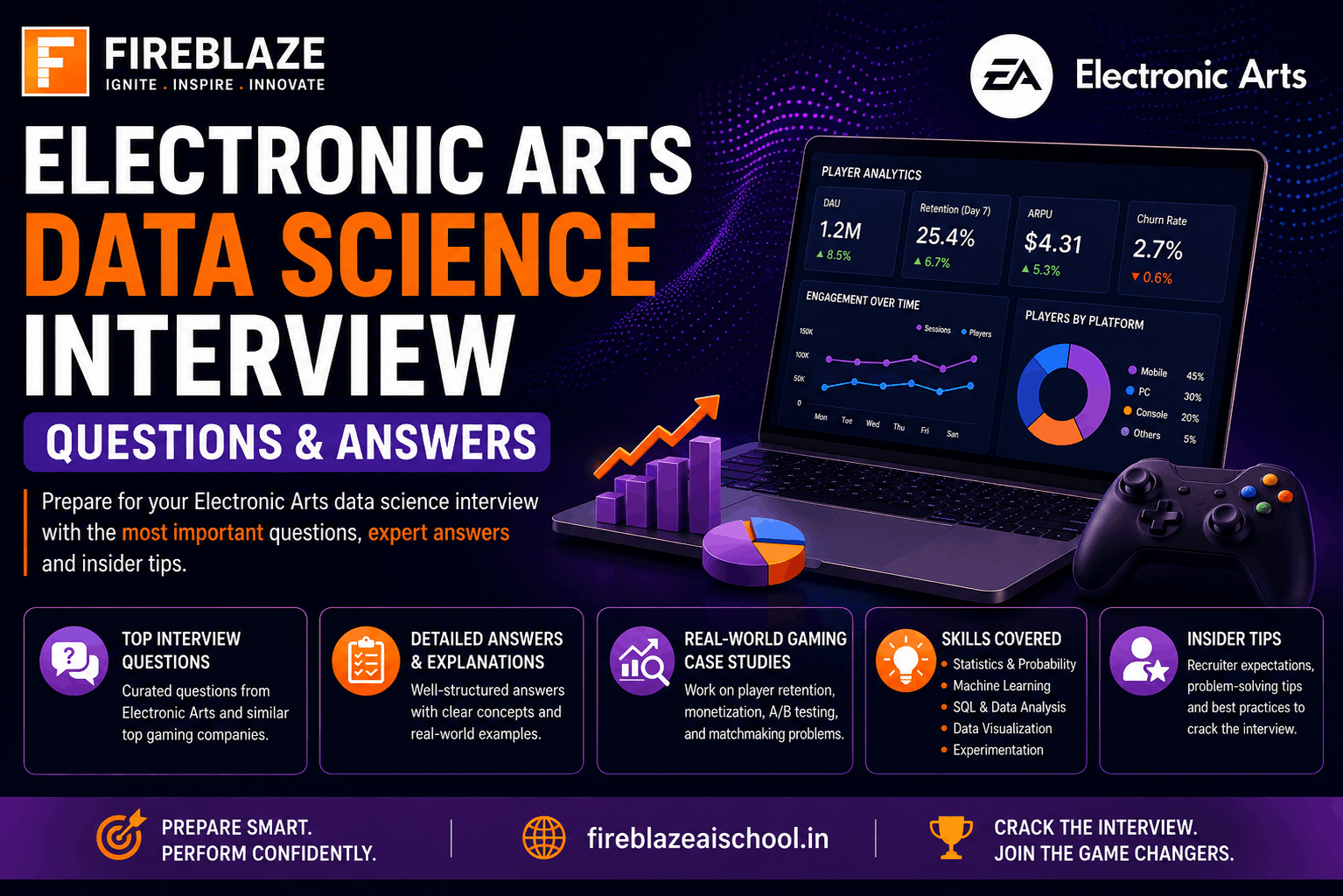
Electronic Arts Data Science Interview Questions and Answers (2026 Guide)
Electronic Arts (EA) is one of the world's leading video game companies, known for popular franchises such as FIFA, EA Sports FC, Battlefield, Apex Legends, Need for Speed, and The Sims.
Modern gaming companies rely heavily on Data Science to improve player experiences, optimize game performance, personalize content, increase engagement, and drive revenue growth.
If you're preparing for a Data Science role at Electronic Arts, understanding analytics, experimentation, machine learning, and player behavior is essential.
This guide covers the most commonly asked Electronic Arts Data Science interview questions and answers.
Why Data Science Matters at Electronic Arts
Gaming companies generate massive amounts of data from:
Player Activity
Match Statistics
In-Game Purchases
User Engagement
Retention Metrics
Multiplayer Interactions
Data Scientists help EA:
Improve Player Retention
Optimize Monetization
Detect Cheating
Personalize Experiences
Enhance Matchmaking Systems
Improve Game Performance
SQL Interview Questions
1. What is SQL?
SQL (Structured Query Language) is used to retrieve, analyze, and manage data stored in relational databases.
It is one of the most important skills for Data Scientists.
2. What is the Difference Between WHERE and HAVING?
WHERE
Filters records before aggregation.
SELECT *
FROM players
WHERE country = 'India';
HAVING
Filters aggregated results.
SELECT country,
COUNT(*)
FROM players
GROUP BY country
HAVING COUNT(*) > 1000;
3. What is an INNER JOIN?
INNER JOIN returns matching records from both tables.
SELECT p.player_name,
m.match_id
FROM players p
INNER JOIN matches m
ON p.player_id = m.player_id;
4. Find Top 10 Players by Total Revenue
SELECT player_id,
SUM(revenue) AS total_revenue
FROM purchases
GROUP BY player_id
ORDER BY total_revenue DESC
LIMIT 10;
5. What are Window Functions?
Example:
SELECT
player_id,
RANK() OVER(
ORDER BY total_score DESC
) AS player_rank
FROM leaderboard;
Window functions are frequently used for rankings and analytics.
Python Interview Questions
6. Why is Python Popular in Data Science?
Python offers powerful libraries including:
Pandas
NumPy
Scikit-Learn
TensorFlow
PyTorch
It simplifies data analysis and machine learning development.
7. What is a DataFrame?
A DataFrame is a tabular data structure provided by Pandas.
import pandas as pd

df = pd.read_csv("players.csv")
8. How Do You Handle Missing Values?
Methods include:
Drop Missing Rows
Fill Mean
Fill Median
Interpolation
Example:
df.fillna(df.mean())
Statistics Interview Questions
9. What is Mean?
Mean represents the average value.
Formula:
Mean = Sum of Values / Number of Values
10. What is Standard Deviation?
Standard deviation measures how spread out data points are from the mean.
Applications:
Performance Analysis
User Behavior Analysis
Revenue Forecasting
11. What is Correlation?
Correlation measures relationships between variables.
Range:
-1 to +1
Example:
Relationship between playtime and spending.
12. What is Hypothesis Testing?
A statistical technique used to determine whether observed results are significant.
Key components:
Null Hypothesis
Alternative Hypothesis
Machine Learning Questions
13. What is Machine Learning?
Machine Learning enables systems to learn patterns from data and make predictions.
14. Difference Between Supervised and Unsupervised Learning
| Supervised Learning | Unsupervised Learning |
|---|---|
| Uses Labeled Data | Uses Unlabeled Data |
| Predictive Models | Pattern Discovery |
| Classification | Clustering |
15. What is Logistic Regression?
A classification algorithm used to predict probabilities.
Gaming applications:
Churn Prediction
Purchase Prediction
Fraud Detection
16. What is Random Forest?
Random Forest combines multiple decision trees to improve prediction accuracy.
Advantages:
High Accuracy
Handles Missing Data
Reduces Overfitting
17. What is Overfitting?
Overfitting occurs when a model performs well on training data but poorly on new data.
Solutions:
Cross Validation
Regularization
More Data
A/B Testing Questions
A/B Testing is heavily used in gaming analytics.
18. What is A/B Testing?
A/B Testing compares two versions of a feature to determine which performs better.
Example:
Testing:
New User Interface
Reward Systems
Matchmaking Algorithms
19. What is a P-Value?
A P-value measures the probability that observed differences occurred by chance.
Common threshold:
P < 0.05
20. What Metrics Would You Track During an A/B Test?
Examples:
Retention Rate
Daily Active Users (DAU)
Revenue
Session Duration
Conversion Rate
Gaming Analytics Questions
21. What is Player Retention?
Player Retention measures how many users continue playing over time.
Common metrics:
Day 1 Retention
Day 7 Retention
Day 30 Retention
Retention is one of the most important gaming KPIs.
22. What is Churn Prediction?
Churn Prediction identifies players likely to stop playing.
Benefits:
Better Engagement Strategies
Personalized Offers
Increased Retention
23. What is Daily Active Users (DAU)?
DAU measures the number of unique players active on a given day.
24. What is Monthly Active Users (MAU)?
MAU measures the number of unique users active within a month.
25. What is DAU/MAU Ratio?
Formula:
DAU / MAU
Used to measure player engagement.
Higher values indicate stronger engagement.
26. How Would You Detect Cheating in a Game?
Potential indicators:
Unusual Win Rates
Impossible Scores
Abnormal Behavior Patterns
Automated Activity
Machine Learning models can identify suspicious accounts.
Scenario-Based Questions
27. A New Game Update Reduced Player Retention. What Would You Do?
Approach:
Analyze retention metrics.
Segment affected users.
Review update changes.
Analyze player feedback.
Perform cohort analysis.
Recommend corrective actions.
28. How Would You Increase In-Game Purchases?
Strategies:
Personalized Recommendations
Limited-Time Offers
Better Reward Systems
User Segmentation
Dynamic Pricing Experiments
29. How Would You Analyze Matchmaking Quality?
Metrics:
Match Balance
Win Rate Distribution
Match Completion Rate
Player Satisfaction
Queue Times
Electronic Arts Data Science Hiring Process
The interview process typically includes:
1. Resume Screening
Recruiters evaluate:
Projects
Technical Skills
Gaming Interest
Analytics Experience
2. Online Assessment
Topics include:
SQL
Statistics
Python
Problem Solving
3. Technical Interview
Focus areas:
Machine Learning
Experimentation
Analytics
Case Studies
4. Product Analytics Round
Questions may involve:
Retention Analysis
Churn Prediction
Player Behavior Analytics
5. Final Interview
Evaluates:
Communication Skills
Business Thinking
Team Collaboration
Electronic Arts Data Scientist Salary
Estimated salary ranges:
| Experience | Salary Range |
|---|---|
| Fresher | ₹8 LPA – ₹15 LPA |
| 1–3 Years | ₹12 LPA – ₹25 LPA |
| 3–5 Years | ₹20 LPA – ₹40 LPA |
| Senior Data Scientist | ₹40 LPA+ |
Compensation depends on experience, location, and technical expertise.
Skills Required for EA Data Science Roles
Technical Skills
Python
SQL
Statistics
Machine Learning
Data Visualization
Analytics Skills
A/B Testing
Product Analytics
Cohort Analysis
Churn Prediction
Gaming Metrics
DAU
MAU
Retention
Lifetime Value (LTV)
Tips to Crack Electronic Arts Data Science Interviews
Master SQL
Practice:
Joins
Aggregations
Window Functions
Complex Queries
Learn Product Analytics
Understand:
User Behavior
Retention Metrics
Cohort Analysis
Build Gaming Analytics Projects
Examples:
Churn Prediction System
Player Retention Dashboard
Matchmaking Analysis
Game Recommendation System
Practice A/B Testing
Gaming companies heavily rely on experimentation for feature optimization.
Final Thoughts
Electronic Arts Data Science interviews focus on a combination of technical expertise, analytics knowledge, experimentation skills, and gaming business understanding.
Candidates who understand SQL, Python, Statistics, Machine Learning, Product Analytics, and Gaming KPIs have a significant advantage.
Building projects related to player retention, churn prediction, recommendation systems, and gaming analytics can greatly improve your chances of securing a Data Science role at Electronic Arts.