 Fireblaze
 AI & Careers
Data Science in Marketing: Transforming Business Through Data-Driven Strategies
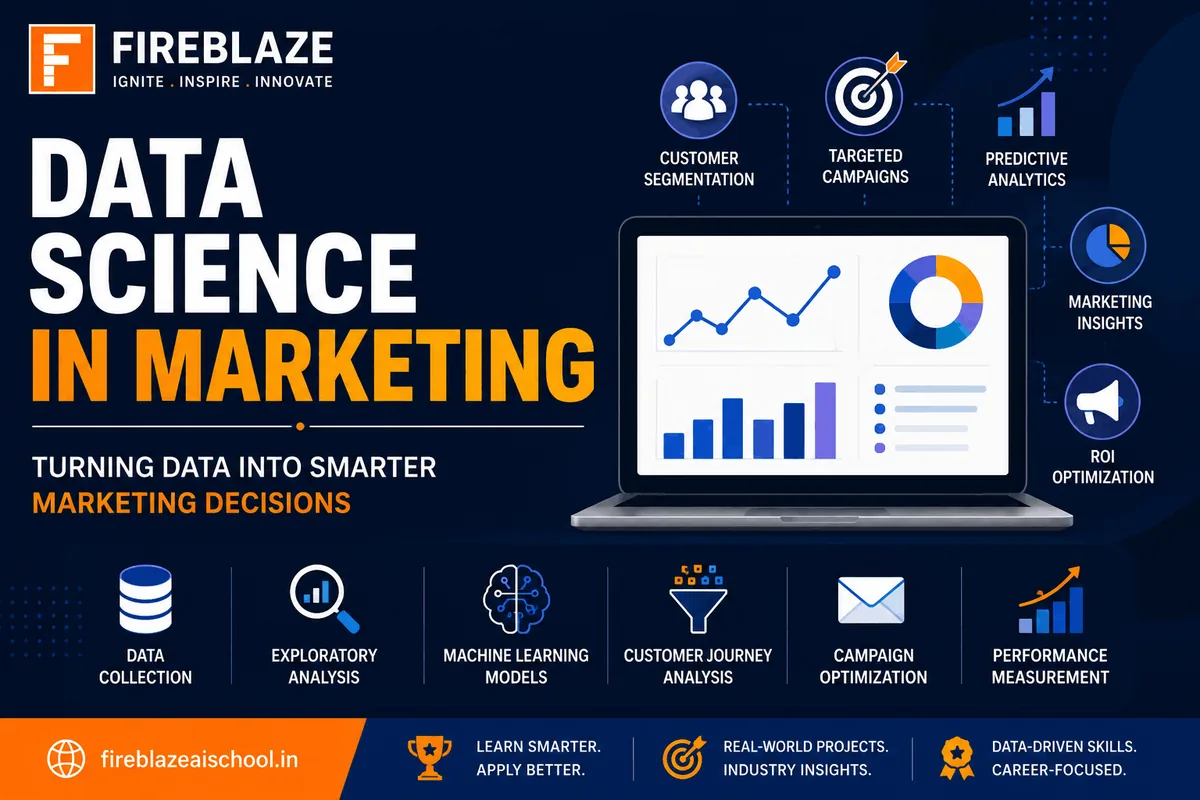
In today's digital world, businesses generate enormous amounts of customer data every second. From website visits and social media interactions to online purchases and customer feedback, every action creates valuable information.
Data Science has revolutionized marketing by helping businesses analyze this data, understand customer behavior, predict future trends, and create personalized experiences. Companies like Amazon, Netflix, Google, Meta, and Spotify heavily rely on Data Science to improve their marketing strategies and increase customer engagement.
In this article, we'll explore how Data Science is transforming marketing, its applications, benefits, tools, and career opportunities.
What is Data Science in Marketing?
Data Science in Marketing refers to the use of data analysis, machine learning, artificial intelligence, and statistical techniques to improve marketing decisions and business outcomes.
Instead of relying on assumptions, marketers use data to:
Understand customer behavior
Predict customer actions
Personalize experiences
Optimize marketing campaigns
Improve customer retention
Increase revenue
Data-driven marketing helps organizations make smarter and more effective business decisions.
Why is Data Science Important in Marketing?
Traditional marketing often depended on intuition and broad targeting strategies.
Modern marketing requires:
Accurate customer insights
Personalized experiences
Better campaign performance
Real-time decision making
Higher return on investment (ROI)
Data Science helps businesses understand what customers want and how they interact with products and services.
How Data Science Works in Marketing
A typical marketing analytics workflow includes:
Step 1: Data Collection
Data is gathered from multiple sources:
Websites
Mobile Apps
Social Media Platforms
CRM Systems
Email Campaigns
Customer Surveys
Step 2: Data Cleaning
Raw data is processed by:
Removing duplicates
Handling missing values
Correcting errors
Standardizing formats
Clean data ensures accurate analysis.
Step 3: Data Analysis
Analysts identify:
Customer trends
Purchasing behavior
Engagement patterns
Marketing performance metrics
Step 4: Predictive Modeling
Machine learning models predict future outcomes such as:
Customer churn
Product purchases
Campaign performance
Customer lifetime value
Step 5: Decision Making
Businesses use insights to improve marketing strategies and customer experiences.
Applications of Data Science in Marketing
Data Science is used across various marketing functions.
1. Customer Segmentation
Customer segmentation divides customers into groups based on:
Age
Gender
Location
Purchasing Behavior
Interests
Example:
An e-commerce company may segment users into:
Frequent Buyers
New Customers
Premium Customers
Inactive Customers
Benefits:
Personalized Marketing
Better Customer Engagement
Higher Conversion Rates
2. Personalized Marketing
Personalization helps businesses deliver relevant content and offers.
Examples:
Product Recommendations
Personalized Emails
Dynamic Website Content
Customized Advertisements
Companies using personalization often achieve higher customer satisfaction and sales.
3. Customer Churn Prediction
Customer churn refers to customers leaving a business or discontinuing a service.
Data Science helps identify:
Customers likely to leave
Reasons behind churn
Retention opportunities
Businesses can proactively retain customers through targeted campaigns.
4. Recommendation Systems
Recommendation engines suggest products or services based on customer behavior.
Examples:
Amazon
Product recommendations.
Netflix
Movie recommendations.
Spotify
Music recommendations.
Benefits:
Increased Engagement
Higher Sales
Better User Experience
5. Marketing Campaign Optimization
Data Science helps marketers evaluate campaign performance.
Metrics analyzed include:
Click-Through Rate (CTR)
Conversion Rate
Cost Per Click (CPC)
Return on Investment (ROI)
Businesses can optimize campaigns for better performance and lower costs.
6. Predictive Analytics
Predictive analytics uses historical data to forecast future outcomes.
Applications include:
Sales Forecasting
Demand Prediction
Customer Behavior Prediction
Marketing Budget Planning
Predictive models help organizations make proactive decisions.
7. Sentiment Analysis
Sentiment analysis examines customer opinions and emotions from:
Social Media Posts
Product Reviews
Surveys
Customer Feedback
Benefits:
Brand Monitoring
Customer Satisfaction Measurement
Reputation Management
Natural Language Processing (NLP) is commonly used for sentiment analysis.
8. Customer Lifetime Value Prediction
Customer Lifetime Value (CLV) estimates the total revenue a customer may generate throughout their relationship with a business.
Benefits:
Better Customer Prioritization
Improved Marketing Spend Allocation
Enhanced Retention Strategies
Businesses focus more on high-value customers.
Key Marketing Metrics Analyzed Using Data Science
Marketing teams rely on various metrics.
Customer Acquisition Cost (CAC)
Measures the cost of acquiring a new customer.
Formula:
CAC = Marketing Cost / New Customers
Customer Lifetime Value (CLV)
Measures the total value generated by a customer.
Formula:
CLV = Average Purchase Value × Purchase Frequency × Customer Lifespan
Conversion Rate
Measures the percentage of visitors who complete a desired action.
Formula:
Conversion Rate = Conversions / Total Visitors × 100
Return on Investment (ROI)
Measures marketing profitability.
Formula:
ROI = (Revenue - Cost) / Cost × 100
Machine Learning in Marketing
Machine Learning plays a major role in modern marketing.
Popular algorithms include:
Linear Regression
Used for sales forecasting.
Logistic Regression
Used for churn prediction.
Decision Trees
Used for customer segmentation.
Random Forest
Used for predictive analytics.
K-Means Clustering
Used for customer grouping.
Neural Networks
Used for recommendation systems and personalization.
Tools Used in Marketing Data Science
Python
Popular libraries:
Pandas
NumPy
Scikit-Learn
Matplotlib
SQL
Used for data extraction and analysis.
Power BI
Used for dashboards and reporting.
Tableau
Used for data visualization.
Google Analytics
Tracks website performance and user behavior.
Looker Studio
Creates interactive marketing dashboards.
Real-World Examples of Data Science in Marketing
Amazon
Uses recommendation systems to increase product sales.
Netflix
Personalizes content recommendations using customer viewing behavior.
Spotify
Creates personalized playlists and music recommendations.
Google Ads
Uses machine learning to optimize advertising performance.
Meta (Facebook & Instagram)
Uses predictive analytics and customer targeting to improve ad effectiveness.
Benefits of Data Science in Marketing
Organizations gain several advantages.
Better Customer Understanding
Analyze customer needs and preferences.
Improved Personalization
Deliver highly relevant experiences.
Higher Conversion Rates
Optimize campaigns for better results.
Increased Revenue
Improve customer acquisition and retention.
Smarter Decision Making
Use data rather than assumptions.
Competitive Advantage
Stay ahead of market trends.
Challenges of Data Science in Marketing
Despite its advantages, challenges exist.
Data Privacy Concerns
Businesses must comply with privacy regulations.
Data Quality Issues
Poor-quality data can lead to incorrect decisions.
Integration Complexity
Combining data from multiple sources can be difficult.
Skill Gaps
Organizations require skilled Data Scientists and Analysts.
Future of Data Science in Marketing
Emerging trends include:
AI-Powered Personalization
Real-Time Marketing Analytics
Predictive Customer Journeys
Marketing Automation
Generative AI Content Optimization
Hyper-Personalized Advertising
Data Science will continue to shape the future of marketing and customer engagement.
Career Opportunities in Marketing Analytics
Popular roles include:
Marketing Data Analyst
Business Analyst
Data Scientist
Product Analyst
Customer Insights Analyst
Digital Marketing Analyst
The growing adoption of data-driven marketing continues to create strong demand for analytics professionals.
Skills Required for Marketing Data Science
To build a career in this field, learn:
Technical Skills
SQL
Python
Power BI
Tableau
Statistical Skills
Probability
Hypothesis Testing
Regression Analysis
Marketing Knowledge
Customer Behavior
Digital Marketing
Campaign Analytics
Customer Journey Mapping
Why Learn Data Science for Marketing?
Marketing is becoming increasingly data-driven.
Benefits include:
High Demand Career Opportunities
Strong Salary Potential
Business Impact
AI and Analytics Exposure
Professionals with both marketing and analytics skills are highly valued across industries.
Final Thoughts
Data Science has transformed modern marketing by enabling businesses to understand customers, personalize experiences, optimize campaigns, and make data-driven decisions. From customer segmentation and churn prediction to recommendation systems and predictive analytics, Data Science is now at the heart of successful marketing strategies.
Whether you're a student, marketer, or aspiring Data Scientist, learning Data Science in Marketing can open doors to exciting career opportunities in one of the fastest-growing fields in business and technology.
Suggested Internal Links
Introduction to Data Science
Machine Learning Algorithms and Applications
Customer Segmentation Using Machine Learning
Predictive Analytics Explained
Data Science Career Roadmap
Artificial Intelligence in Business
Focus Keyword
Data Science in Marketing
Secondary Keywords
Marketing Analytics
Data-Driven Marketing
Customer Analytics
Predictive Analytics in Marketing
Machine Learning in Marketing
Marketing Data Science
Keep Reading
Related Articles
AI & Careers
Best AI Tools for Students in 2026
Students in 2026 have more AI tools than ever to simplify learning from AI note takers and research assistants to writing helpers, coding tutors, and flashcard
Will AI Replace Data Analysts? An Honest Answer
AI is changing the job rather than removing it. Here is which parts are automating, and what that means for someone starting out.
Generative AI Skills Every Data Analyst Needs in 2026
Which AI skills employers actually expect from analysts now, and the verification habits that separate useful from dangerous.