Beginner’s Guide to TensorFlow: Complete Introduction for Data Science and AI
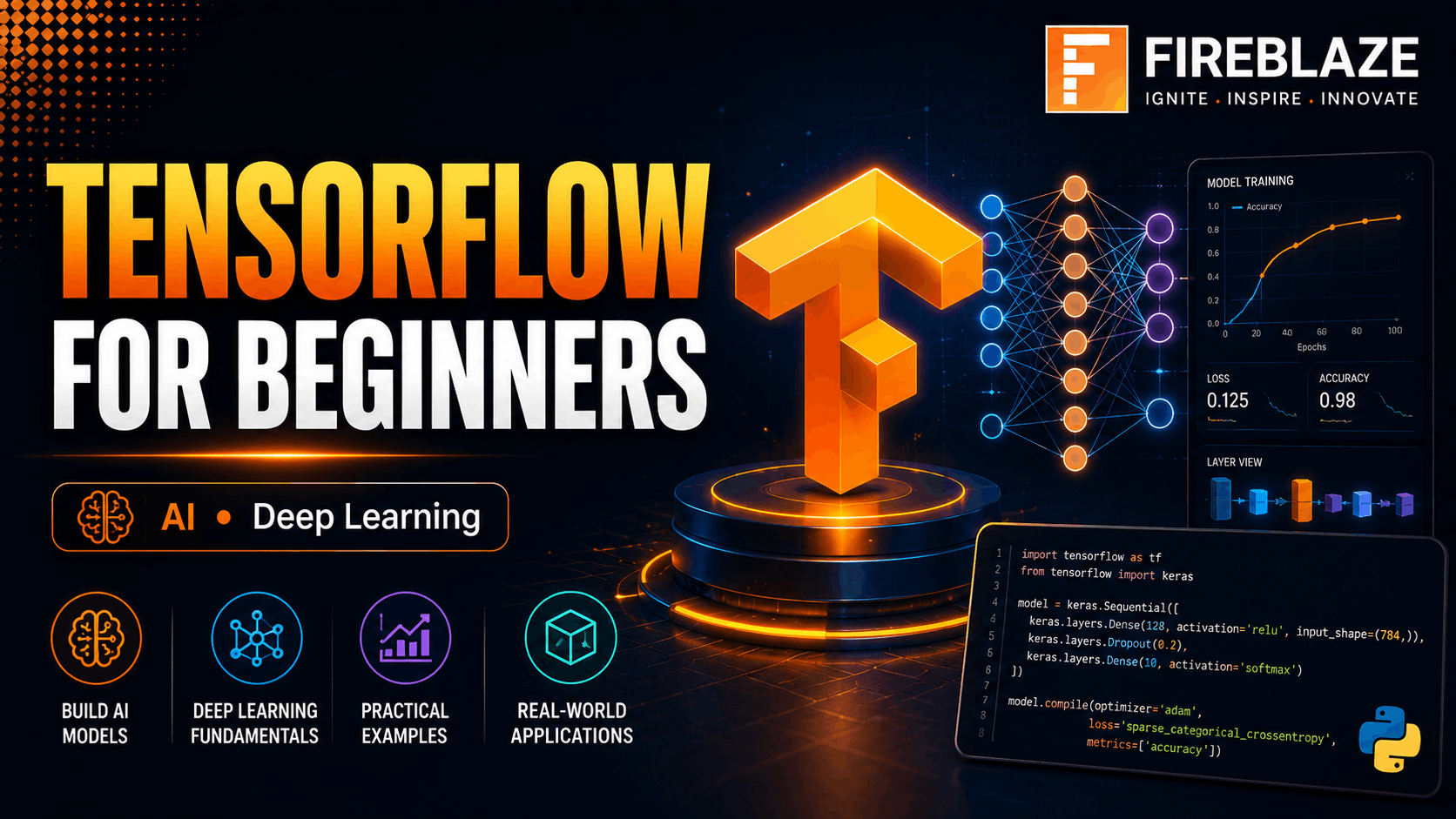
Beginner’s Guide to TensorFlow: Complete Introduction for Data Science and AI
Artificial Intelligence (AI) and Machine Learning (ML) have transformed industries ranging from healthcare and finance to education and entertainment. Behind many modern AI applications lies a powerful framework called TensorFlow.
TensorFlow is one of the world's most popular open-source Machine Learning and Deep Learning frameworks. Developed by Google's Brain Team, it enables developers and Data Scientists to build, train, and deploy machine learning models efficiently across multiple platforms.
If you're new to AI and Machine Learning, this guide will help you understand TensorFlow from the ground up.
What is TensorFlow?
TensorFlow is an open-source software library used for Machine Learning and Artificial Intelligence applications. It is particularly known for training and deploying neural networks and deep learning models.
TensorFlow supports:
Machine Learning
Deep Learning
Neural Networks
Computer Vision
Natural Language Processing (NLP)
Recommendation Systems
It was originally developed by Google's Brain Team and released as open-source software in 2015.
Why is TensorFlow Popular?
TensorFlow is widely used because it offers:
✅ Open-source framework
✅ Strong community support
✅ Scalable architecture
✅ GPU and TPU acceleration
✅ Production-ready deployment
✅ Integration with Keras
It can run on:
Windows
Linux
macOS
Mobile Devices
Cloud Platforms
TensorFlow is designed to work across CPUs, GPUs, and specialized AI hardware such as TPUs.
What is a Tensor?
The word TensorFlow comes from two terms:
Tensor
A tensor is a multi-dimensional data structure.
Examples:
0D Tensor = Scalar
1D Tensor = Vector
2D Tensor = Matrix
3D Tensor = Multi-dimensional Array
Flow
Flow represents the movement of data through computational operations.
TensorFlow processes data by passing tensors through computational graphs.
TensorFlow Architecture
TensorFlow follows a computational graph approach.
Basic flow:
Input Data
↓
Data Processing
↓
Model Training
↓
Prediction
↓
Deployment
This architecture helps scale machine learning workloads efficiently.
Installing TensorFlow
Install TensorFlow using pip:
pip install tensorflow
Verify installation:
import tensorflow as tf

print(tf.__version__)
First TensorFlow Program
Creating a simple tensor:
import tensorflow as tf

x = tf.constant([1, 2, 3])

print(x)
Output:
tf.Tensor([1 2 3], shape=(3,), dtype=int32)
TensorFlow and Keras
Modern TensorFlow comes with Keras integrated.
Keras is a high-level API that simplifies model building and training. TensorFlow uses Keras as its primary interface for developing machine learning models.
Example:
from tensorflow import keras

model = keras.Sequential()
Building Your First Neural Network
Simple example:
import tensorflow as tf
from tensorflow import keras

model = keras.Sequential([
    keras.layers.Dense(10, activation='relu'),
    keras.layers.Dense(1)
])
This creates a neural network with:
Input Layer
Hidden Layer
Output Layer
What is Deep Learning?
Deep Learning is a subset of Machine Learning that uses neural networks with multiple layers.
Applications include:
Image Recognition
Speech Recognition
Chatbots
Self-Driving Cars
Recommendation Systems
TensorFlow is one of the leading frameworks for Deep Learning development.
TensorFlow Workflow
A typical workflow includes:
Step 1: Collect Data
Example:
Images
Text
Sales Data
Sensor Data
Step 2: Preprocess Data
Tasks include:
Missing Value Handling
Normalization
Feature Engineering
Step 3: Build Model
Using TensorFlow and Keras.
Step 4: Train Model
Example:
model.fit(X_train, y_train)
Step 5: Evaluate Model
Example:
model.evaluate(X_test, y_test)
Step 6: Make Predictions
Example:
predictions = model.predict(new_data)
Applications of TensorFlow
TensorFlow powers many AI applications.
Computer Vision
Examples:
Face Detection
Object Detection
Medical Image Analysis
Natural Language Processing (NLP)
Examples:
Chatbots
Language Translation
Sentiment Analysis
Recommendation Systems
Examples:
Netflix Recommendations
YouTube Suggestions
E-Commerce Recommendations
Time Series Forecasting
Examples:
Sales Prediction
Stock Market Analysis
Demand Forecasting
TensorFlow vs Scikit-Learn
| Feature | TensorFlow | Scikit-Learn |
|---|---|---|
| Deep Learning | Yes | Limited |
| Neural Networks | Advanced | Basic |
| Large Scale Training | Excellent | Moderate |
| GPU Support | Yes | No |
| Beginner Friendly | Moderate | High |
TensorFlow Advantages
Benefits include:
Open Source
High Performance
Cross Platform
Scalable
Production Ready
Strong Community Support
TensorFlow Limitations
Challenges include:
Steeper Learning Curve
More Complex than Scikit-Learn
Requires More Computing Resources
For simple Machine Learning tasks, beginners often start with Scikit-Learn before moving to TensorFlow.
TensorFlow Interview Questions
What is TensorFlow?
TensorFlow is an open-source Machine Learning and Deep Learning framework developed by Google for building and deploying AI models.
What is a Tensor?
A tensor is a multi-dimensional array used to store and process data.
What is Keras in TensorFlow?
Keras is TensorFlow's high-level API used for building neural networks easily.
What are TensorFlow Applications?
Applications include:
Computer Vision
NLP
Recommendation Systems
Predictive Analytics
Deep Learning
What is the Difference Between TensorFlow and PyTorch?
TensorFlow is widely used for production deployment, while PyTorch is popular in research and experimentation.
Learning Roadmap for TensorFlow
Step-by-step roadmap:
Step 1
Learn Python
Step 2
Learn NumPy and Pandas
Step 3
Understand Machine Learning Basics
Step 4
Learn Neural Networks
Step 5
Learn TensorFlow and Keras
Step 6
Build Real Projects
Examples:
Image Classifier
Chatbot
Sentiment Analysis System
Recommendation Engine
Real-World Companies Using TensorFlow
Many organizations use TensorFlow for AI solutions, including:
Technology Companies
Healthcare Organizations
Financial Institutions
E-Commerce Platforms
Research Labs
TensorFlow remains one of the most widely adopted deep learning frameworks in production environments.
Final Thoughts
TensorFlow is one of the most powerful and widely used frameworks for Machine Learning and Deep Learning. Its ability to build scalable AI solutions, support neural networks, and deploy models across multiple platforms makes it an essential skill for aspiring Data Scientists, Machine Learning Engineers, and AI professionals.
For beginners, the best approach is to first learn Python and Machine Learning fundamentals, then gradually move into TensorFlow and Deep Learning projects. With consistent practice and hands-on implementation, TensorFlow can become a valuable tool for building intelligent applications and advancing a career in Artificial Intelligence.